21 June 2006

Strings 2006 – Day 3

In Toronto last year there was a nice talk by Albert de Roeck from CERN, about the LHC and how it could find signals of string theory like extra dimensions, mini black holes, and so on. This year B. Greene (not the author of The Elegant Universe) did the same with cosmology. In a very optimistic tone he said that stringy effects could be found first in cosmology rather than in particle physics. It is nice to see that some people are really worried about the gap between theory and experiment in string theory and are trying to fill the gap. It is really important that this sort of work be done since all experiments are dedicated and the experimentalists must know where to look.

Another very interesting talk was given by Staudacher. He gave a nice review about the status of anomalous dimensions in QCD and N=4 gauge theories, integrability and string theory. At the end he remarked that transcendentality may not be fundamental after all.

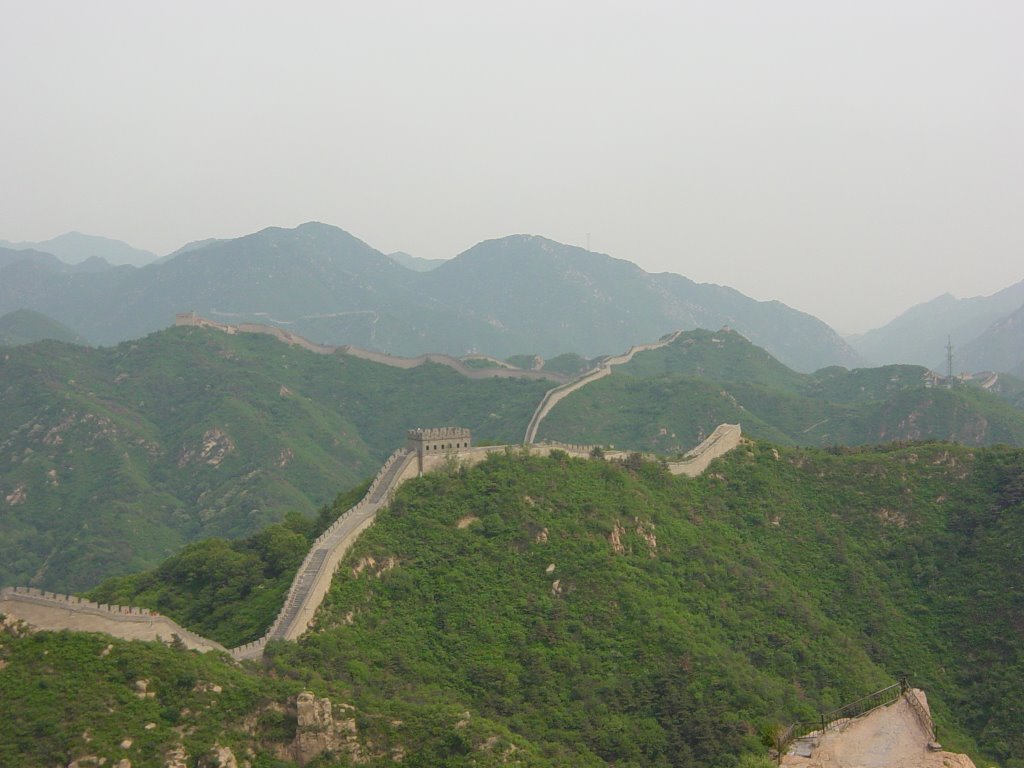
In the afternoon we went to the Great Wall. It is quite impressive. I can show you a picture but the real thing is much better.


In the evening we had Chinese opera. Very nice. Of course, most of the participants didnÂ’t understand the singers but the visual was magnificent.

On the commercial side, the Becker sisters and Cambridge were promoting their new book, co-authored with John Schwarz String Theory and M-Theory which will be released in November. There is a 20% discount for the conference participants which pre-order a copy. Also, there was a CUP stand during the first two days trying to sell specially string books. Today there was a stand of a bookshop selling CUP books which were specially produced for China. You could find Weinberg's book on QFT or Polchinski'’s book on string theory by about 10 dollar each volume. Who can compete with China in this way?

UPDATE: Dear Peter, see what happened with the alternative B. Greene in the next post: Day 4.

UPDATE: Dear S. Chan, I think prof. Yau is doing a great job in China. He participated in the solution of one of the greatest mathematical problems and brought two new institutes to China among other things. I have never attacked him. If fact I am surprised to know that China has such a tradition in mathematics. All this is very positive to science in China.

20 June 2006

Strings 2006 - Day 2

Today there were many talks and I will comment on some of them. For the full list see the program. The first talk was given by Maldacena and was about giant magnons. Since there is a believe that the N=4 supersymmetric gauge theory is integrable there is a lot of activity trying to show that using the AdS/CFT correspondence. For the moment you just find some sector of the gauge theory which can be mapped to a spin chain and look for the corresponding string theory hoping that you can gain some understanding for the full theory.

Feng gave a interesting talk about dark matter and supergravity. After presenting arguments that DM could be composed by gravitinos he said that the LHC could produce long lived sparticles that decay into gravitinos. These sparticles would then be stored in a tank of water and the gravitino properties studied. That is fantastic. Not just susy would be found at LHC but also supergravity! Freedman, Ferrara and van Nieuwenhuizen, who have just won a prize from the American Physical Society for the discovery of sugra, must be very happy.

Herman Verlinde showed how to do string phenomenology bottom-up. Just moosify the standard model. In the panel discussion that happened yesterday he suggested that all smart string theorist should be doing phenomenology because the LHC will start soon. He has a point. We have to understand what will come out of the LHC. But I don't believe many people will change as he changed. Each one has his own recipe for success.

Another good talk was giving by David Tong on how to use string and D-brane techniques to understand the quantum dynamics of field theory solitons.

To those interested I can not google or access wiki in any language.

Tomorrow there will be a tour so there will be fewer talks.

Almost forgot, after dinner we had a special seminar by Yau telling the history of the Poincaré conjecture and how he solved it! Again, high school students in the audience but less than in the Great Hall of the People yesterday. Also a video from Hamilton, a mathematician who participated in the solution, telling Yau's contribution to maths. Quite impressive that China has such a tradition in mathematics. And for the Chinese students, sitting among the scientists of the West, it must have been wonderful to hear that his teacher solved such an important problem. Looks like China soon will take the lead also in mathematics.

UPDATE: I can't answer any comment because I can't access blogspot. So I will answer
Peter's question here. Yau gave a public lecture not a technical one. He mentioned several other mathematicians which also gave contributions to the conjecture and explained what they did. He is not claiming that he did it by himself. I am not an expert on the conjecture so I don't know how fair he was in the lecture. But you know, it was a public lecture and Yau is now regarded as a sort of a hero by the Chinese.

19 June 2006

Strings 2006

That is amazing! I can't access my blog (or any blog at blogspot) from Beijing but I can write a post! Probably because to write a post the address is different (blogger instead of blogspot). So let us see for how long I can write. Also, no wireless is available making things more difficult.

Strings 2006 started with 3 public lectures in the Great Hall this morning. The very same place where the communist party holds its meetings. It is quite an impressive building! Besides the string conference participants the place was completely full with high school students. Around 3000 people altogether! The Chinese are investing heavily in education and also getting money from abroad. Two new institutes are being built in China with private donations! And if China gets the international linear collider it will soon became the leader in HEP. No doubt about that.

The first to speak was Gross with a popular talk on strings. The next one was Strominger and surprisingly he started talking in Chinese. The Chinese students liked a lot. He then turned to English to deliver the talk. He presented many cartoons to explain strings and black holes. I was told that he spent one year in China when he was young and then learnt Chinese. That may explain one of his cartoons where he put G. Bush near a black hole to illustrate that everything that goes inside the black hole falls in nothingness. The last lecture in the morning was given by Hawking. Complete chaos until everybody got a picture from him. Then he talked about cosmology and the big bang. No questions were allowed since it was late. Students were asked to write questions which will be answered on Wednesday. The authors of the selected questions will be able to have a picture side by side with Hawking! That is the way to attract young minds to science in Chinese way!

In the afternoon the first lecture was given by Witten on the Langlands program. Essentially the introduction of his 250 pages paper. At the end just one question, whether it could have any application in physics. Witten said that there is an application in his paper. Then Vafa talked about the swampland but nothing new was announced. The next two talks, by Shih and Intriligator, were about the metastable vacua in susy theories. Really nice talks. Then Ooguri talked about the possible uses of the metastable vacua in the landscape. And the final talk was by Yin.

In the evening we had the panel discussion with 13 people. Strominger was chairing it. No real debate. Too mild. Some interesting questions but none of them provocative enough. No discussion on the landscape either. Toronto was much better...

12 June 2006

José Leite Lopes dies in Rio

José Leite Lopes died today in Rio. He was 88 years old and sick. He had a prominent role in several aspects of physics in Brazil. You can read more at CBPF, the last institution he belonged to.

08 June 2006

A educação e a eleição presidencial

Como sempre, às vesperas de qualquer eleição, há uma disputa acirrada sobre feitos e omissões de governos presentes e passados. O governo Lula tem aparecido muito na mídia, criando universidades federais, dando aumento salarial ao funcionalismo federal (professores universitários incluídos) e apoiando explicitamente a ciência e tecnologia através de verbas (e corte de verbas) ao MCT, Finep e CNPq.

Na área da educação, os feitos estão sendo contestados pelo ex-ministro Paulo Renato Souza em Informe-se, presidente, publicado no Estadão. E ele apresenta números que são difíceis de serem ignorados por qualquer pessoa instruída. O atual ministro deveria responder, com números também. Igualmente bom seria que algum ex-ministro de CT comparasse os 8 anos de FHC com os 4 de Lula. Isto pode decidir o voto de muita gente. Ou não.